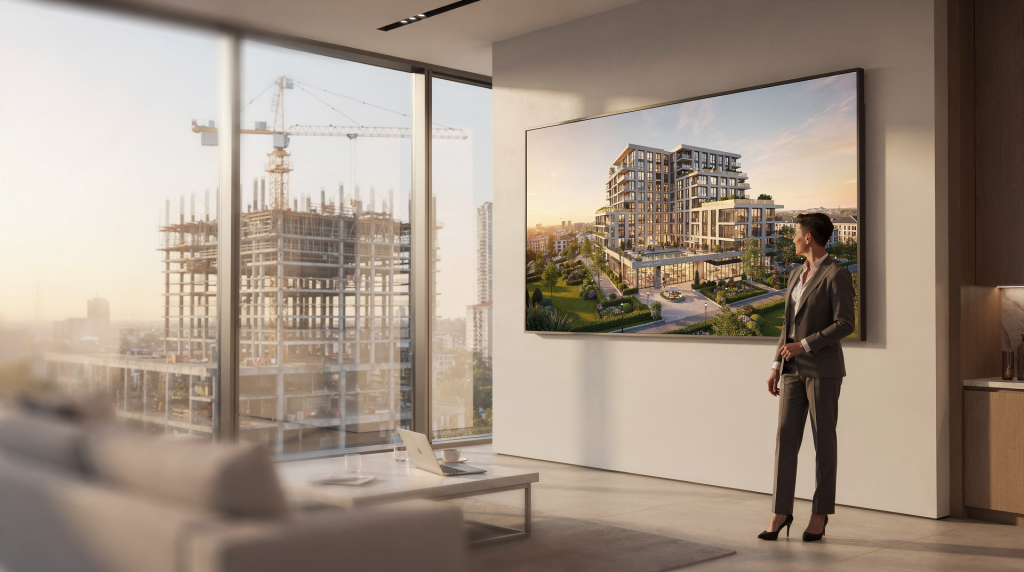
When you spend your days inside 3ds Max, Blender or Unreal Engine building spaces that don’t exist yet, you quickly learn what actually moves a buyer. A good off-plan render isn’t just a pretty picture — it’s a tool that turns uncertainty into something the mind can hold onto. Buyers who can’t walk through a finished show flat need to feel like they’ve already stepped inside. A photorealistic visual gives them that, long before the first brick is laid. It reduces risk emotionally because it answers the question no floor plan ever can: “What will it feel like to live here?”
Why off-plan properties need visualization
Selling off-plan means selling a promise. The layout exists as lines on a drawing, the materials are swatches in a spec sheet, the light is an assumption, and the view is just a description. None of those things feel real to most people — even experienced investors occasionally struggle to translate 2D symbols into a lived-in three-dimensional space. That’s where architectural visualization takes over. Using render engines like V-Ray, Corona or Cycles, we simulate the actual physics of light inside a 3D model calibrated to the architectural plans. Suddenly that corner apartment isn’t a rectangle on a site map; it’s a sunlit room with shadow patterns falling exactly where they would at 3 p.m. in October.
The reason this matters is simple: buyers don’t invest in drawings. They invest in confidence. A well-crafted render answers the hidden questions that nag at every off-plan decision:
- Does the living area feel generous or cramped?
- Can I imagine my sofa against that wall and still have circulation space?
- What’s the quality of the stone, the timber, the ceiling height?
- How does the building sit on the street — does it feel private or exposed?
- When I stand at the window, what exactly am I looking at?
What architectural renders do better than floor plans
Floor plans are the skeleton of a sale. Without them nothing makes sense. But they’re abstract; they demand that the viewer construct a mental model of scale, proportion and atmosphere, and most people — even if they’ve bought several properties — aren’t naturally equipped to do that. A render bridges that gap instantly. It shows the real size of a room by placing a dining table that looks right, by letting the daylight fall across the floor finish, by demonstrating how the open-plan kitchen genuinely connects to the lounge. In practice, I’ll often frame an interior shot with a 24–28mm lens on a full-frame virtual camera: wide enough to convey the flow of space but not so wide that you distort the proportions and mislead the buyer. That single decision influences how truthful and persuasive the image feels.
A solid off-plan render does things a 2D drawing simply cannot:
- It fills an empty shell with a believable, fully-finished look that brings a sense of home.
- It reveals how spaces relate to each other — the enfilade through from entrance to terrace, the visual overlap between kitchen island and sofa.
- It communicates the tactile quality of materials: honed marble versus glossy lacquer, textured wallpaper versus smooth microcement.
- It anchors the price by giving substance to the finish level the developer promises.
- For buyers thousands of miles away, it becomes the primary site inspection.
The main sales benefits of architectural renders
1. They help buyers imagine ownership
The psychological job of a render is to move someone from “I see a unit” to “I could live here.” That shift happens through a hundred tiny realistic details: the way a linen throw sits on the armchair, a magazine and coffee cup on a side table, the soft glow of a floor lamp in an evening scene. As a rendering artist, I’ve seen that the subtlest cues — like choosing the right IES profile for a downlight so it throws a believable pool of light on a textured wall — do more for emotional connection than any dramatic camera angle. These details make the property feel personal, not theoretical.
2. They improve early-stage sales
Most off-plan developments need commitments before the scaffolding goes up. Lenders want to see market appetite, and investors need something concrete to evaluate. Photorealistic renderings are not optional extras at this stage — they’re the primary artifacts that carry the sales narrative. I’ve worked on projects where the hero exterior shot, paired with a couple of key interior vignettes, unlocked funding conversations that simply wouldn’t have happened with plans and mood boards alone. The key is to pick views that speak to the unique selling points: a corner window floodlit by morning sun, a rooftop terrace with an actual city panorama stitched from drone photography, an entry sequence that feels genuinely grand.
3. They reduce hesitation
Uncertainty is the friction that kills off-plan conversions. Buyers worry about light quality, about whether the master bedroom will feel narrow, about whether the balcony is actually usable. A render removes guesswork if it’s built honestly: the sun position should match the unit’s real orientation, the glazing should reflect the specified frame thickness, and the furniture should be scaled to the architectural plan. When I’m setting up a scene, I always cross-check the window mullions against the architect’s detail drawings; it’s easy to make a window look floor-to-ceiling in a render, but if the real frame is chunky and breaks the view, the misleading image will backfire. Accurate rendering sets a credible baseline that calms buyer anxiety.
4. They strengthen the whole marketing package
A single render isn’t enough, but a coordinated set of visuals acts like a brand identity for the development. That consistency flows from a unified post-processing grade applied across stills, the same material palette appearing in 3D floor plans, and the same lighting mood threading through brochure, website and sales gallery screen. In production, this means setting up LUTs and tone mapping early, and agreeing on a visual language — warm and residential, crisp and contemporary, soft and organic — so that every output reinforces the same story. The same assets then serve property portals, social ads, email campaigns and investor presentations without looking patchworked together.
Which types of renders sell off-plan properties best
No single format does everything. The strongest campaigns layer multiple types of visualization, each playing a distinct role at different points in the buyer’s journey. Below is the cheat sheet I work from when advising developers on their visual package.
| Render type | Best use | Why it helps |
|---|---|---|
| Exterior render | First impression, brochure cover, ads | Shows the building, architecture, and street presence clearly. The HDRI should reflect local sky conditions — a London scheme needs overcast softness, a Dubai project demands harsh sun and sharp shadows. |
| Interior render | Unit-level sales | Helps buyers imagine day-to-day living and finish quality. Physically based materials (PBR) are non-negotiable: the difference between a convincing timber floor and a plastic-looking one often comes down to roughness maps and correct IOR values. |
| Lifestyle render | Premium positioning | Creates emotion and aspirational appeal. Often slightly wider angle, human figures or pets added in post to suggest the life that happens in the space. |
| 3D floor plan | Layout explanation | Makes circulation and room relationships easier to read. I build these from the same 3D model as the photorealistic interiors so the furniture placement is consistent. |
| Aerial render | Masterplan and site context | Shows the development within its surroundings. Important to use accurate GIS or drone data for the context model so buyers understand proximity to parks, transport, and neighbouring buildings. |
| Animation or walkthrough | Launch campaigns and investor decks | Tells a story and explains flow better than a static image. Real-time engines like Unreal Engine have made these far more accessible, but timing and camera movement need as much care as the lighting. |
What makes a render persuasive, not just pretty
A beautiful image that doesn’t reflect the real unit erodes trust. I’ve seen renders with so much bloom and cinematic fog that the space looked like an art installation — gorgeous, but nothing like the actual apartment would ever feel. The most credible renders balance aspiration with rigorous accuracy. They respect the plan, the material specifications, the true window openings, and the light conditions dictated by the site orientation. If the real view looks onto a neighbouring brick wall, the render shouldn’t pretend it’s a sweeping skyline — but it can still frame the shot to show the quality of interior space while being honest about what’s outside the window.
A useful checklist for sales-driven renders
- Keep the architecture faithful to the plans — no fudging ceiling heights or moving structural columns to improve composition.
- Match materials to approved specifications: if the joinery is a specific RAL colour, sample it directly in the shader.
- Show realistic lighting for the unit’s orientation — if the apartment faces north, use soft skylight, not dramatic low sun.
- Reflect actual views where possible, using photomontage techniques or accurate proxy geometry beyond the window.
- Avoid exaggerated furniture scale — always model or import furniture to real-world dimensions aligned with the plan.
- Use a lived-in look, not an empty showroom: strategic accessories, subtle imperfection in soft furnishings, plausible items on shelves.
- Label images clearly as artist impressions — usually in small print but unambiguous, to manage buyer expectations.
That last point isn’t just legal protection — it’s a signal of professionalism. Buyers understand that a render is a visualization of the planned property; being upfront about it actually builds credibility rather than undermining it.
How developers should use renders in the sales process
Renders work hardest when they’re present at every decision point. A single hero shot pinned to a listing portal is a start, but it’s the coordinated visual story that keeps a buyer moving forward — from initial curiosity to reservation. I’ve learned to treat the visual production not as a one-time deliverable but as a parallel track to the sales timeline, where imagery evolves as the buyer’s questions evolve.
Recommended workflow
- Start with the floor plan and unit mix to identify which layouts will bear the heaviest visual load.
- Decide which units need a bespoke render and which can use a standard template — this avoids blowing the budget while still covering key sales inventory.
- Produce exterior images for the overall project story, making sure the architecture reads clearly from the main approach angle.
- Create interior renders for the most marketable layouts, usually the ones with the best light, the highest price, or the most distinctive features.
- Add 3D floor plans for clarity — these are particularly useful for open-plan spaces where the flow isn’t obvious from a single camera angle.
- Use the same visuals across brochures, website, and sales materials, maintaining a unified colour grade and material consistency.
- Keep the render models live and update them promptly when design details change — nothing damages trust like a sales brochure showing a different kitchen than the one being built.
Where renders usually have the highest impact
- New-build launches — the visual drop creates the first wave of interest.
- Show apartment campaigns — a well-rendered show flat can generate the buzz even before the physical fit-out is ready.
- International buyer marketing — renders replace the inability to visit, so they need to answer every practical and emotional question.
- Premium unit sales — for penthouses and signature residences, multiple renders (day, dusk, views) can reflect the premium price.
- Investment decks — clean, well-annotated render inserts prove the development’s market positioning.
- Off-plan portal listings — the thumbnail is often the make-or-break click, so it needs to read instantly and honestly.
Common mistakes that weaken off-plan marketing
Even technically high-quality renders can fail if the fundamentals aren’t there. These are the ones I see cropping up again and again in portfolios, pitch decks, and sales galleries:
- Beautiful, but not the real unit. The render shows a sleeker, more spacious version of the plan. When the buyer compares the image to the dimensional drawings, the discrepancy is obvious and trust evaporates.
- Cinematic over practical. Heavy atmosphere, dramatic contrast, and lens flares can look stunning on screen, but they obscure the very information a buyer needs: how much storage is there, what’s the material, does the second bedroom actually fit a bed?
- Wrong natural light direction. If the apartment faces east and the render shows golden evening light streaming through the main windows, an informed buyer will immediately question the rest of the presentation.
- Overcrowded or under-scale furniture. Either extreme misleads. A dining table that’s too large makes the room feel generous when it isn’t; a tiny sofa makes an already modest living room look even less functional.
- Clone-stamp interiors. Reusing identical furniture layouts and colour schemes across all unit types kills any sense of individuality. Even small variations — a different rug, a shift in accessory palette — make each unit feel like a genuine home.
- Missing views and amenity value. Balconies left empty, windows showing only white void, no hint of the communal garden or the rooftop terrace — these silences weaken the lifestyle story.
- Mixed visual styles. If the exterior render is a crisp, high-contrast daytime shot and the interiors are moody, desaturated night scenes, the campaign feels incoherent and cheapens the perceived quality.
The result of any of these is confusion, and in off-plan sales confusion kills momentum faster than any competitor.
How to brief a render that actually helps sell
If the objective is conversion rather than portfolio pageantry, the brief needs to be rooted in buyer psychology and product clarity. Aesthetic preference matters, but it should serve the sale, not override it.
Include these inputs in the brief
- Approved floor plans — ideally as vector PDFs or DWGs so the modelling is accurate to the millimetre.
- Material and finish schedule — with actual sample references, not just generic descriptors like “oak”.
- Target buyer profile — first-time buyers expect different emotional cues than downsizers or investors.
- Price band and positioning — the render should visually justify the price without misleading about what’s included.
- Unit orientation and view notes — a rough sun study or a site photo from the window position saves hours of guesswork.
- Competitor examples — images from schemes in a similar market segment that the developer admires or wants to differentiate from.
- Sales message for the development — is the headline “urban sanctuary” or “connected living”? That should inform the atmosphere, not just the copy.
- Required image formats for web, print, and social — specifying aspect ratios and resolution up front avoids re-renders.
Ask these questions before approving final images
- Does this image help a buyer understand the space — or does it just look impressive on a retouching reel?
- Does it reflect the actual product accurately, down to the skirting profile and switch plates?
- Does the quality of light, texture and composition support the intended price point?
- Will it still make sense when paired with the brochure copy, or will the words describe something the image doesn’t show?
- Can this single render work for both the sales gallery display and a compressed social media ad?
When renders should be updated
Off-plan projects evolve. A revision to the facade cladding, a tweak to the glazing specification, a redesigned balcony balustrade — any change that touches what the buyer expects to receive means the visuals should be reviewed. Outdated renderings are a liability: they mislead, weaken trust, and create awkward conversations during snagging and handover. I’ve learned the hard way that even a minor landscaping change around the entrance — replacing a rendered planter with a different species — can matter to a buyer who chose the apartment partly because of that first impression image.
A practical rule: if the change alters anything visible in an existing render, flag it and assess whether a revision is needed. It’s far cheaper to update a 3D scene and re-render a couple of frames than to deal with a disappointed purchaser later.
FAQ
Are architectural renders enough to sell an off-plan property on their own?
No. Renders are powerful, but they don’t replace the legal and factual framework of a sale: floor plans, specifications, pricing breakdowns, payment schedules, and clear contractual terms are all essential. Renders are the emotional layer that sits on top of that factual foundation. When the two align, the sales package becomes difficult to resist.
Do buyers trust renders?
Generally yes — but only when the visual is credible and clearly labeled as an artist’s impression. Trust erodes quickly if the render is overly stylized, if it hides awkward corners, or if it contradicts the written description. I always advise clients to show a few ‘honest’ angles — perhaps a view from the entry door showing the actual width of a corridor — rather than only the most flattering hero shots.
What type of render sells best for off-plan homes?
There isn’t a single champion. Exterior renders do the heavy lifting for first impression and brand, while interior renders and 3D floor plans close the deal at the unit level. The strongest campaigns use all three. In practice, a potential buyer often moves through an exterior image on a portal, then clicks into a gallery of interior vignettes, and only then examines the floor plan with the visuals fresh in mind.
Are animations better than still images?
Animations are superb for launch events and storytelling — they give a cinematic sense of arrival and journey. But still images remain more practical for brochures, property listings, and targeted unit sales because they’re faster to produce, easier to distribute, and require less attention span from the viewer. A well-composed still will often be the asset that gets shared on social media, not a three-minute YouTube walkthrough.
Can renders help sell to overseas buyers?
Absolutely. When a buyer can’t visit the site, the render becomes the primary surrogate for the physical experience. That’s why it’s so important for these assets to include accurate context views, realistic daylight conditions, and a clear explanation of the layout. I’ve worked on several projects where the bulk of sales to international investors happened entirely on the strength of a comprehensive visual pack, supplemented by video calls where we walked them through the 3D scenes live.
Conclusion
Architectural renders help sell off-plan properties by converting uncertainty into something much more tangible: understanding. They take the lines of a floor plan and turn them into a space that a buyer can almost walk into — a place where they can imagine morning light, a quiet evening, or a gathering of friends. The goal for developers and marketers isn’t just to commission beautiful images. It’s to produce visuals that answer real buyer questions at every stage of the journey, from “What does the building look like from the street?” to “How will my bedroom feel at sunrise?” When that chain of answers is complete, the sale follows naturally.